Leadership Playbook · Stephanie Bacon, PhD
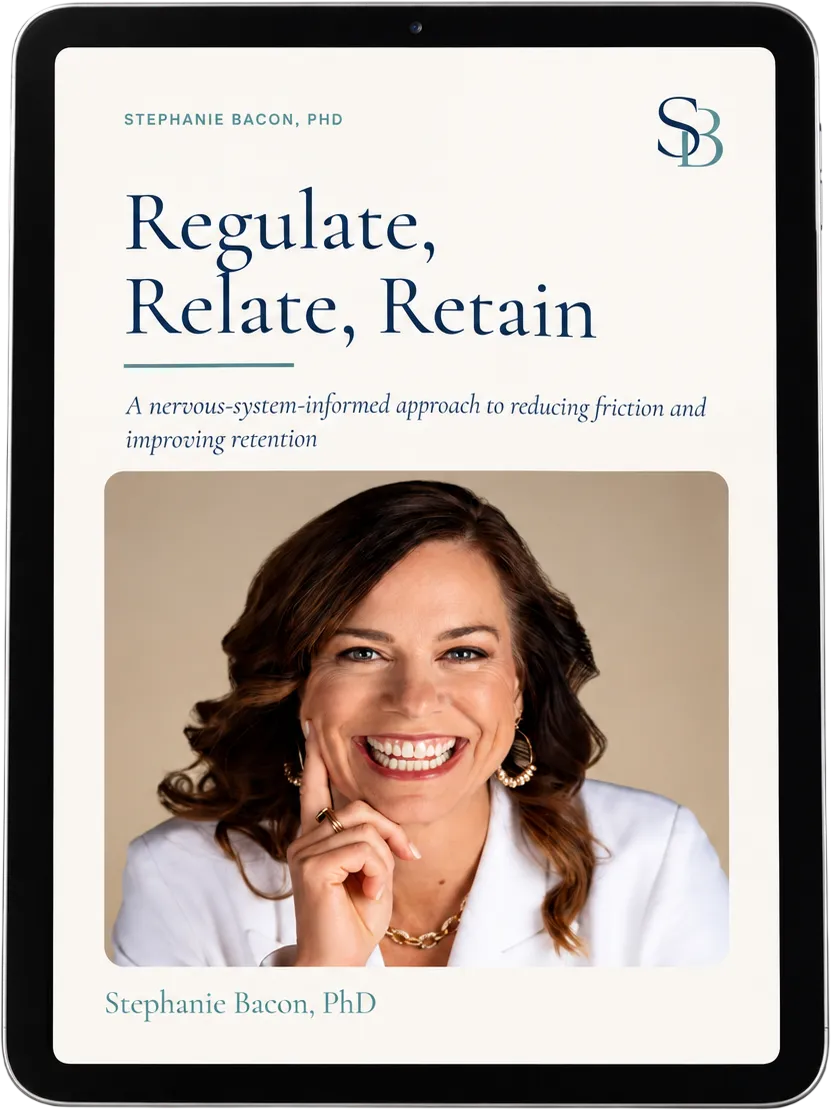
Regulate, Relate, Retain.
A nervous-system-informed approach to reducing friction and improving retention.
Your best people may not be leaving because they stopped caring. Sometimes the quieter problem is the state from which decisions are being made: overloaded, guarded and running on very little capacity.
Get instant access
Enter your details and we'll send you the Leadership Playbook.
By submitting, you agree to receive the playbook and related leadership communications.
Regulate
Change the state from which you decide
Relate
Communicate, connect and repair
Retain
Reduce preventable friction that makes good people leave
The Pattern Hiding in Your Budget
When capacity becomes the constraint, effort alone doesn't fix the pattern.
Capable people can make costly decisions while overloaded, guarded and depleted. Chronic overload changes the state from which people communicate, solve problems and make decisions.
The playbook frames burnout, checkout and turnover as outcomes of a dysregulated system—not simply a lack of talent or commitment.
“The cycle is identical, and so is the fix. Regulate. Relate. Retain.”
$8.9T
Gallup's 2024 report estimated that low employee engagement costs the global economy roughly 9% of GDP, valued at $8.9 trillion.
Source cited in the playbook: Gallup, State of the Global Workplace 2024.
The Three Movements
A practical framework for reducing friction
The book follows a sequential case from overload and protective behavior to regulation,
safer connection and retention.
01
Regulate
Physiology first, because behavior does not start in the mind.
Learn to notice the state you are making decisions from and create enough capacity to respond intentionally.
02
Relate
Regulation creates room to choose. Relational Intelligence shapes what you do with it.
Build the capacity to listen, take responsibility, set boundaries, communicate clearly and repair harm.
03
Retain
Retention is an outcome, not a program.
Reduce the preventable friction that makes good people leave while paying attention to workload and working conditions.
Part One · Regulate
Change the state from which you decide.
Your nervous system is continuously scanning for safety or danger. When it reads safety, perspective and patience become more accessible. Under threat, protective patterns can take over.
Notice the signal
Learn to notice the state you are making decisions from and create enough capacity to respond intentionally.
Create space
Use regulation practices to increase your capacity to respond intentionally instead of reacting automatically.
Then decide
Ask what you are actually feeling and what is true underneath it before deciding or entering a difficult conversation.
“Regulate, then decide. Regulate, then relate.”
Part Two · Relate
Regulation is not enough.
A leader can be calm and grounded and still be the reason people go quiet. Relational Intelligence turns regulation into safer human-to-human connection.
Capacity
Nervous-system awareness and the ability to notice and influence your state.
Competence
Knowing yourself, reading others and understanding the impact of your decisions.
Position
The relational moves you make under pressure: curiosity, response, responsibility, honesty and boundaries.
Own your part
“I could have given you clearer direction on this.”
Set the boundary
Name the limit before frustration becomes resentment.
Ask before you assume
“Help me understand what shifted.”
Name the need
“What I need is more notice before the scope changes.”
Explain the no
Explain the reason and the trade-off instead of leaving a rejection unexplained.
Reopen and repair
“That conversation didn't go the way I wanted. I'd like to try it again.”
Part Three · Retain
Retention is an outcome of what people repeatedly experience.
Better interactions can support retention by helping teams surface strain, communicate honestly, set boundaries and repair conflict. The book also emphasizes that regulation cannot compensate for chronic understaffing, unreasonable workloads or harmful working conditions.
The ROI of Less Friction
The goal is not to claim that one breathing practice transforms a balance sheet. The value is in reducing preventable patterns that quietly drain it: losing good people, repeating conversations, delaying decisions, failed change adoption and discovering problems after they become expensive.
Regrettable turnover & time-to-fill
Rework, repeated meetings & decision latency
Change adoption & avoidable escalation
Absenteeism, disengagement & productivity
Speak-up patterns & problems surfaced early
Workload, staffing, role clarity & recovery time
Hi, I'm Stephanie
For 25 years I worked next to people who were doing everything right and still hitting a wall.

Not from lack of effort. Not from lack of intelligence. From lack of capacity. Capacity is not a character trait. It is a physiological state, and it can be rebuilt. I watched brilliant leaders lose access to their own best thinking in the middle of a hard week, and then blame themselves or the team.
My doctoral research confirmed what I had already seen. When the nervous system is overloaded for long enough, clear thinking, honest conversations, and decisions made well are the first things to go. That is the gap I work in. When it closes, the ripple moves fast.
Dr. Stephanie Bacon, PhD
A Retention Check for Leaders
Questions that surface the truth before an exit interview does.
Use these questions to examine your own state, the safety around truth, and the systems creating friction.
Ask yourself:
Your own state
Am I making this decision from clarity, or from pressure?
Where am I stacking new asks on a team that is already maxed out?
Safety and truth
Who has gone quiet lately, and when did it start?
What truth is not making it into the room?
When someone brings me a problem, do they come back next time, or go silent?
Am I rewarding honesty, or rewarding the people who tell me things are fine?
The system
Which recent decisions reduced friction, and which added it?
Why are we launching something new on top of things we have not finished?
Where is stress spreading through this team, and where is steadiness?
The Framework
Regulate. Relate. Retain.
If your organization's outcomes depend on people who are not perfect, this is the work: change the state from which you decide, use that capacity to communicate and repair, and reduce the preventable friction that makes good people leave.
Stephanie Bacon, PhD · stephanie-bacon-phd.com
© Stephanie Bacon, PhD · Leadership Playbook
Regulate · Relate · Retain